

The Institutional Mindset does not choose “better.” It chooses utility. We deploy ETFs for tax-loss harvesting and intraday exposure management. We utilize Mutual Funds for specific, capacity-constrained active strategies where the manager requires capital lock-up to execute. The vehicle must serve the strategy, not constrain it.
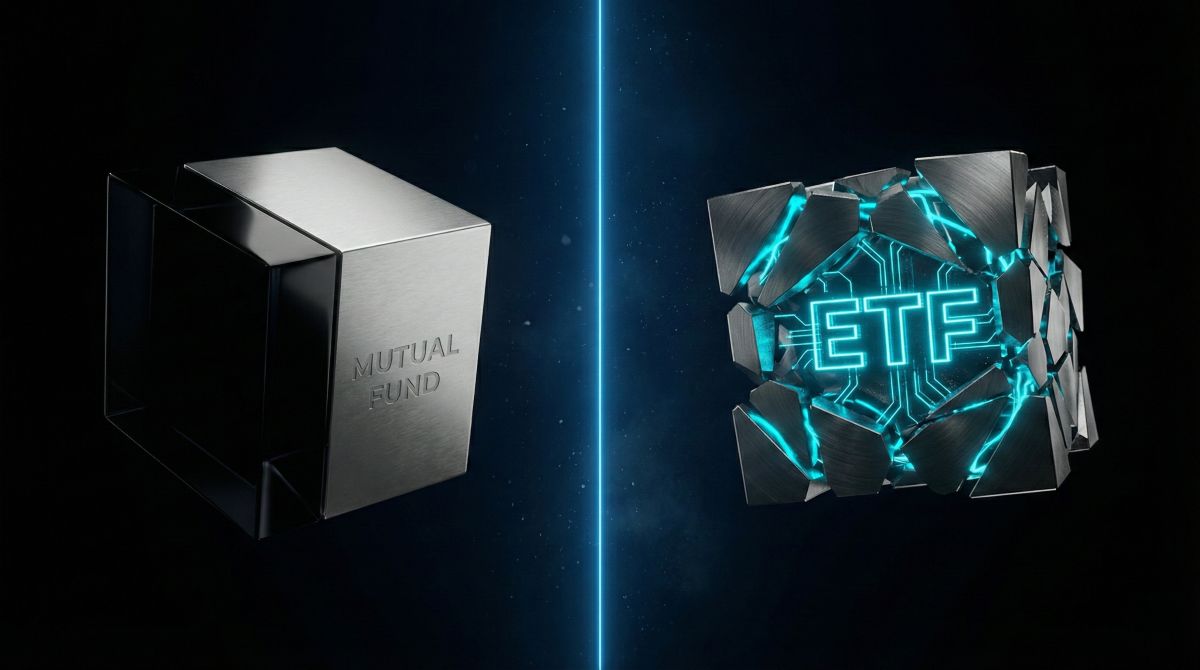
The Architecture of Capital
The retail market is obsessed with the contents of the box. The institutional market is equally concerned with the construction of the box itself. When we allocate capital, the distinction between an Exchange Traded Fund (ETF) and a Mutual Fund is not a matter of preference—it is a matter of structural engineering.
To the uninitiated, they appear identical: baskets of securities providing diversification. To the strategist, they represent two opposing philosophies regarding time, taxes, and transparency.
The Mutual Fund: The Static Fortress
The Mutual Fund is the legacy architecture of the wealth management industry. It is designed for the “accumulation phase” mindset of the mid-20th century.
The Mechanism: When you invest in a Mutual Fund, you are transacting directly with the fund company. Cash flows in; units are created. Cash flows out; securities are sold to redeem units. This creates a critical structural vulnerability: Capital Gains Contagion.
If other investors panic and redeem their shares, the fund manager is forced to sell assets to meet those redemptions. This triggers capital gains taxes that are distributed to all shareholders—even those who held firm. In a Mutual Fund, you are effectively subsidizing the panic of strangers.
The Utility: Despite this, the fortress has a purpose. Active management in less liquid markets (such as high-yield debt or emerging micro-caps) often requires the protection of a Mutual Fund structure. It allows the manager to ignore intraday noise and execute a long-term thesis without the pressure of real-time pricing.
The ETF: The Liquid Conduit
The ETF is the modern instrument of precision. It democratized the ability to treat a basket of assets with the same agility as a single stock.
The Mechanism: The ETF relies on the “In-Kind Creation/Redemption” process. When buying or selling, you are transacting on an exchange with other market participants, not the fund itself. Market makers create or destroy shares by exchanging the underlying securities, not cash.
This architecture creates a tax firewall. The selling of one investor does not trigger a taxable event for another. It is a closed loop of efficiency. Furthermore, the ability to trade intraday allows for tactical entry and exit points that the end-of-day pricing of Mutual Funds cannot match.
The Utility: For passive exposure, factor investing, and sector rotation, the ETF is superior. It offers lower costs, higher tax efficiency, and immediate liquidity. It is the vehicle of choice for the “Core-Satellite” approach, where the core beta is obtained cheaply and efficiently.

The Liquidity Premium
The defining difference is the price of liquidity. Mutual Funds price once per day, at the Net Asset Value (NAV) close. You do not know the price you received until the market is closed. This is acceptable for a 30-year horizon but disastrous for tactical pivots.
ETFs price continuously. However, this introduces the “Bid-Ask Spread.” You pay a premium for immediacy. In highly liquid markets (S&P 500), this cost is negligible. In illiquid markets, the spread can erode returns. The “Institutional Mindset” calculates this spread as a cost of doing business—a fee paid for the option to exit instantly.
The Verdict on Structure
Do not fall into the trap of thinking one is universally superior. That is retail thinking.
Choose the ETF when you require tax efficiency in taxable accounts, when you desire intraday control, or when you are accessing liquid indices.
Choose the Mutual Fund when accessing a star manager in a niche, illiquid market where the fund structure protects the strategy from market volatility.
We are not collectors of funds. We are architects of wealth. Select the material that supports the weight of your legacy.